
Modern vs. Contemporary: Which Style Works Best for a Fully Custom Interior?
Few questions cause more confusion at the start of a design project than this one. Homeowners arrive at the initial consultation describing the home they want as “modern,” then pull up reference images that are, in fact, contemporary. Others insist on “contemporary” while gravitating toward pieces pulled directly from the mid-century canon. The two words are used interchangeably in everyday conversation, but inside a design studio they describe two genuinely different disciplines. Getting the vocabulary right before you brief a designer changes everything about the outcome, especially when the project involves full custom manufacturing rather than retail selection.
This is one of the most common conversations we have at our Paramus showroom, and it is worth slowing down for.
Why the Distinction Matters
Modern and contemporary are not synonyms. Modern refers to a specific historical movement with a fixed visual grammar. Contemporary refers to what is happening in design right now, which means contemporary is always shifting, while modern is, by definition, finished. For anyone planning a full interior in the greater New Jersey and New York region, understanding the difference is the first step toward a home that feels intentional rather than borrowed from a magazine spread.
Defining Modern
Modern design traces its roots to the early twentieth century, emerging from the Bauhaus school and evolving through the mid-century period. Its vocabulary is remarkably consistent: clean geometry, flat planes, warm natural woods (walnut, teak, oak), restrained palettes dominated by neutrals and earth tones, and the guiding principle that form should follow function.
A modern interior is disciplined. Ornamentation is removed. Furniture sits low and horizontal. Wood is shown in its natural grain rather than lacquered. Lighting is architectural and recessed, or takes the form of the now-iconic pendants and floor lamps designed between 1930 and 1965. The silhouette of a modern room is almost always rectilinear.
The historical foundation is well documented through institutions such as The Museum of Modern Art, which houses the design objects and architectural archives that shaped the movement. Understanding those origins helps clarify why a truly modern interior feels so quiet, restraint is the whole point.
Defining Contemporary
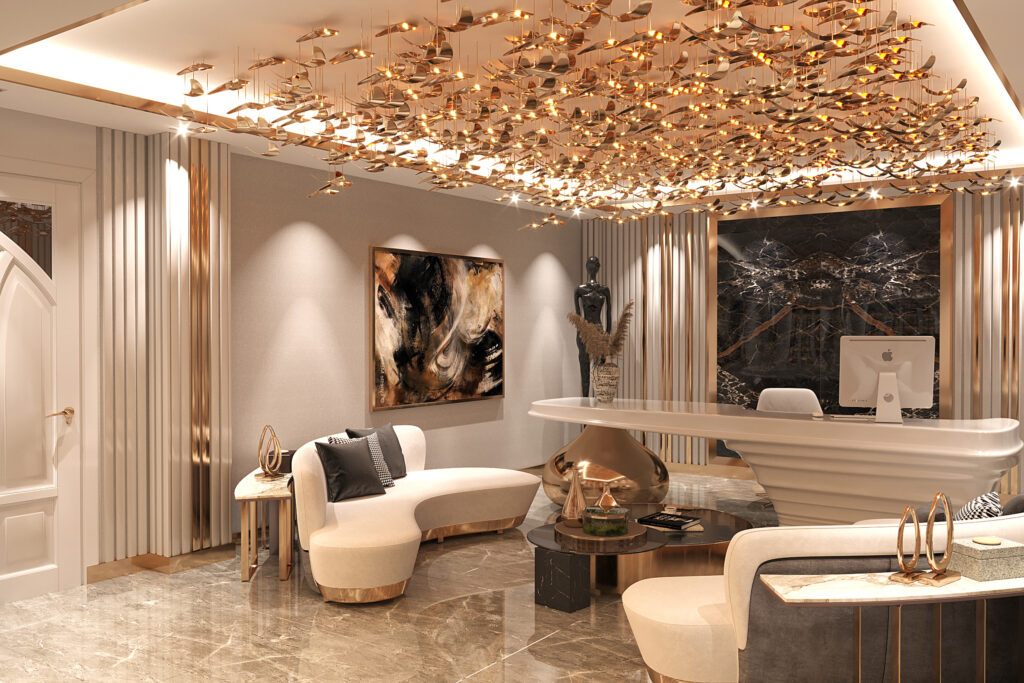
Contemporary design is fluid. It borrows what it finds useful from any era, including modernism itself, and layers in whatever the current moment is offering. Where modern commits to straight lines, contemporary welcomes curves, sculptural forms, and unexpected silhouettes. Where modern tends to one dominant material, contemporary mixes metals freely, brushed brass against blackened steel, polished nickel beside matte bronze. Where modern restrains the palette, contemporary explores moody jewel tones, layered textures, and statement wall treatments.
Contemporary interiors also tend to incorporate the newest material innovations. Ultra-compact surfaces like Dekton and Neolith, which were not available to modernist architects, now appear as seamless countertops, waterfall islands, and cladding for fireplaces. Lighting becomes sculptural, something to look at, not just something to see by. Seasonal editorials from publications like Elle Decor consistently illustrate how quickly the contemporary vocabulary evolves from one year to the next.
How the Two Styles Diverge in Materials and Finish
The material palette is where the difference becomes tangible. A modern kitchen will often specify matte-finish cabinetry in rift-cut white oak, natural stone countertops with subtle veining, and honed surfaces throughout. A contemporary kitchen in the same footprint might specify high-gloss lacquered fronts, an engineered ultra-compact slab with dramatic book-matched veining, mixed metal hardware, and a sculptural pendant over the island.
In bathrooms, modern favors a single stone carried from floor to vanity to shower wall, with fixtures in a consistent finish. Contemporary bathrooms layer, a fluted vanity in one wood, a porcelain feature wall behind the tub, a freestanding tub with a softened silhouette, and fixtures in two complementary metals.
Flooring tells the same story. Italian wood flooring in a wide plank with visible grain reads modern. The same plank in a darker stain, laid in a herringbone pattern beside a poured or honed stone threshold, reads contemporary.
How Each Style Expresses Across the Rooms You Care About
Kitchens, bathrooms, and full-room living concepts are where most of our clients commit to a direction, and each style expresses itself differently across them. A modern living room centers on a low-profile sectional, a walnut coffee table with a clean edge, and a single sculptural light fixture. A contemporary version of the same room might feature a curved upholstered sofa, a travertine coffee table, a layered rug, floor-to-ceiling drapery, and custom wall paneling that introduces texture without ornament.
The supporting elements, custom rugs, chandeliers, drapery, wallpapers, and cabinetry hardware, are what complete either composition. These are rarely afterthoughts in a full custom project; they are specified at the same time as the architecture. That cohesion is exactly what our residential interior design services are built to deliver, regardless of which direction a client ultimately chooses.
Which Style Suits Which Architecture
The architectural envelope matters more than most homeowners realize. Modern tends to sing inside loft-like volumes, flat-roof new builds, and open floor plans where the geometry of the architecture is already doing much of the visual work. Contemporary, by contrast, adapts beautifully to traditional homes being updated from the inside, the kind of renovation common across Alpine and Englewood Cliffs, where the exterior preserves its original character while the interior evolves toward something more current.
Neither style is superior. They answer different questions the house is asking.
The Case for a Hybrid
The most sophisticated interiors we develop rarely sit strictly inside one label. Clients who genuinely love both aesthetics are often best served by a hybrid, borrowing the discipline and restraint of modernism for the architectural bones (cabinetry geometry, flooring, millwork) and allowing contemporary expressiveness to lead in the soft layers (upholstery silhouettes, lighting, textiles, decorative surfaces). Custom manufacturing is what makes this possible. Off-the-shelf furniture forces a commitment to one category or the other; pieces built to your specification do not.
Pre-production 3D rendering is the final step that removes the guesswork. Before a single material is cut or a panel is veneered, the entire room is visualized in full scale, which is the only reliable way to see whether a hybrid scheme is holding together.
A Short Decision Framework
Three questions, asked honestly, usually settle the direction:
- What is my architectural envelope already saying? Open-plan and linear tends toward the modern. Traditional or transitional tends toward contemporary.
- How do I want the home to age? Modern freezes a moment in time deliberately. Contemporary invites evolution.
- Am I drawn to discipline or to expression? Both are valid; they produce very different rooms.
Frequently Asked Questions
Is modern design dated? No, modern is a historical style, which means it has already earned the label “timeless.” Mid-century pieces have held their value for seventy years.
Can contemporary interiors feel timeless? Yes, when the bones are restrained and only the decorative layers are current. The risk comes from committing the architecture itself to a trend.
How do I commit to a style when I like elements of both? Work with a team that can custom-manufacture the pieces. The hybrid is only possible when nothing is off-the-shelf.
Muttimo Luxury Concept is a turnkey custom interior design firm headquartered in Paramus, NJ, delivering bespoke residences and commercial environments across Northern New Jersey and the greater New York region. Our 9,000-square-foot Paramus Park showroom lets you experience both aesthetics at full scale before a single decision is finalized. For verified location details and client reviews, visit our custom interior designer in Paramus, NJ profile.
Begin the Conversation
Whether your vision leans modern, contemporary, or somewhere thoughtfully in between, the direction becomes clearer the moment you stand inside the materials. Schedule your exclusive design consultation, or visit our Paramus showroom to begin your transformation. All custom projects are developed through an initial design consultation and budget alignment, ensuring every detail is resolved before production begins.